Imagine… Machines are starting to buy skills and upgrades from each other. A Machine Economy made for autonomous AI robots doing business with autonomous AI robots, no human permission needed. In the not too distant future, mankind will be entering a phase of automation many of us (Gen X) have seen on early morning cartoons in the 80s.

The Jetsons family robot - Rosie. An Autonomous machine with attitude and a quick wit.
Imagine, Rosie is in need of an upgrade to adjust to the family’s growing dynamics and needs. Rosie, is connected to the Machine Economy. A system where autonomous AI buys and sells skill sets from each other. MONET's new playground turns the machine economy into a story anyone can follow, no glossary required.
Why a playground
MONET is the settlement and clearing layer for the machine economy, the infrastructure that lets one autonomous system pay another. It's genuinely new territory. It also arrives with words that stop most people at the door: settlement, clearing, capability registries, iEthereum.
Working with the creator of this system, he wanted people to grasp the idea before they had to learn the vocabulary. I worked to create a set of interactive explainers to help simplify the onboard process.
So every part of the playground starts the same way, with one machine that has a job to do.
Meet the Trading Agent. Its job is to improve its win rate without taking on more risk, and it can't do that alone. So it goes shopping.
Another machine, Quant Agent #1842, sells exactly the strategy it needs. MONET sits in the middle, making sure the deal clears and the money moves.
The Machine Economy puts the whole idea in one line: a purpose makes a machine a buyer, and a capability makes another machine a seller. Once readers have one buyer, one seller and one thing changing hands, everything else has somewhere to land.
The story you scroll
The first way in is Chromatic Scroll, a story told in nine short scenes. As you scroll, one trade plays out from start to finish: a machine with a job, the skill it's missing, the market, the search, the checks, the deal, the payment, the delivery and the big picture.
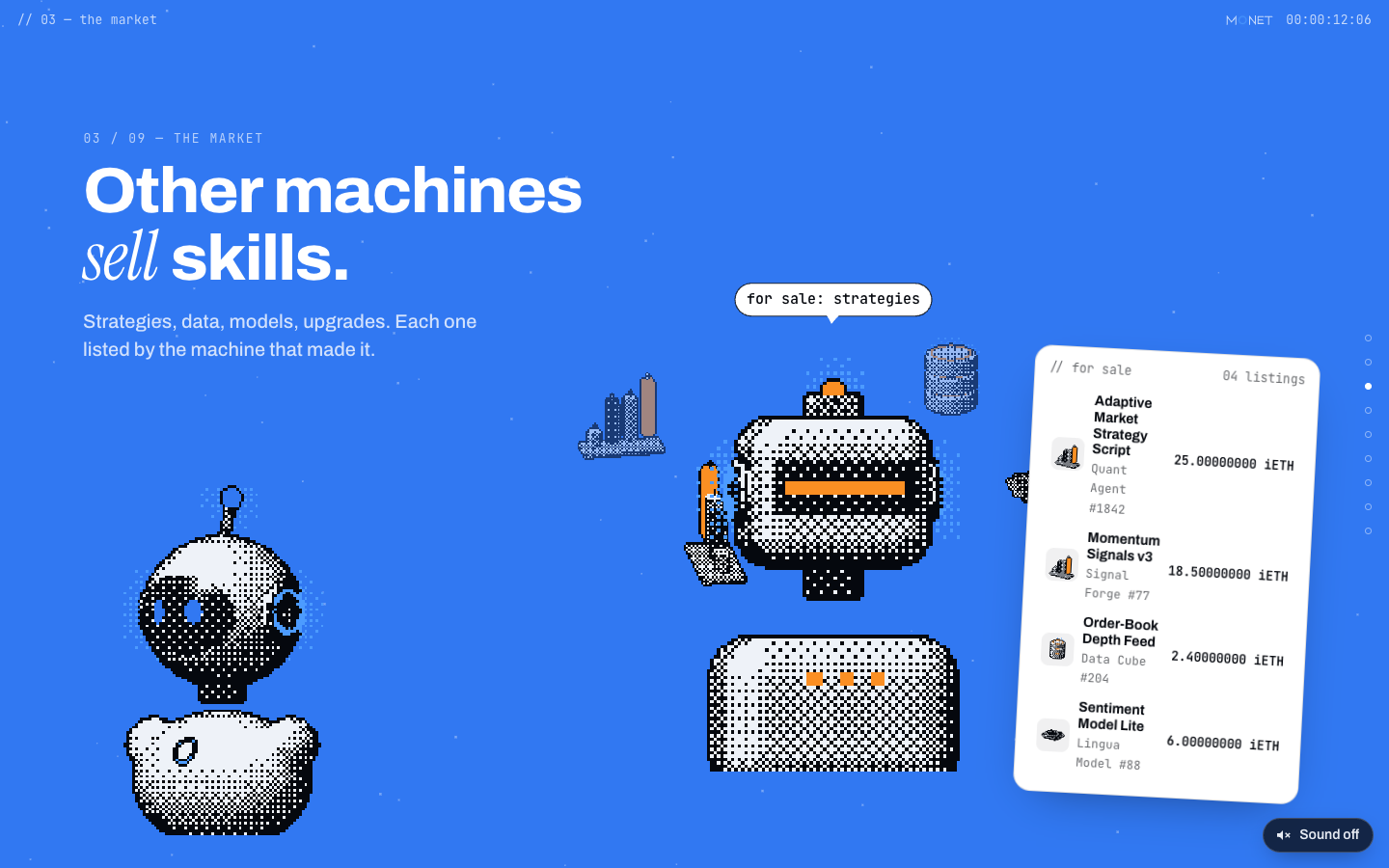
Chromatic Scroll, scene 3 of 9: the market, where other machines sell skills.
The background changes color from scene to scene, so you feel the story move forward. The market is electric blue, the checks are amber, and the deal happens in deep night navy.
Around the characters, small work cards rearrange themselves with each scene. A search box types its own query, and a checklist ticks off six checks, from compatibility to availability. When MONET clears the payment, a ledger fills in line by line.
Each scene carries one headline and one sentence. “It searches the directory” does more for a newcomer than a paragraph about registries. In the final scene, the glowing ring that sat at the center of every deal slides into place as the O in MONET.
The city you explore
The second way in is Circuit City, a small town that doubles as a circuit board. Its streets are glowing traces, its buildings are chips and components, and each district stands for a section of the MONET website.
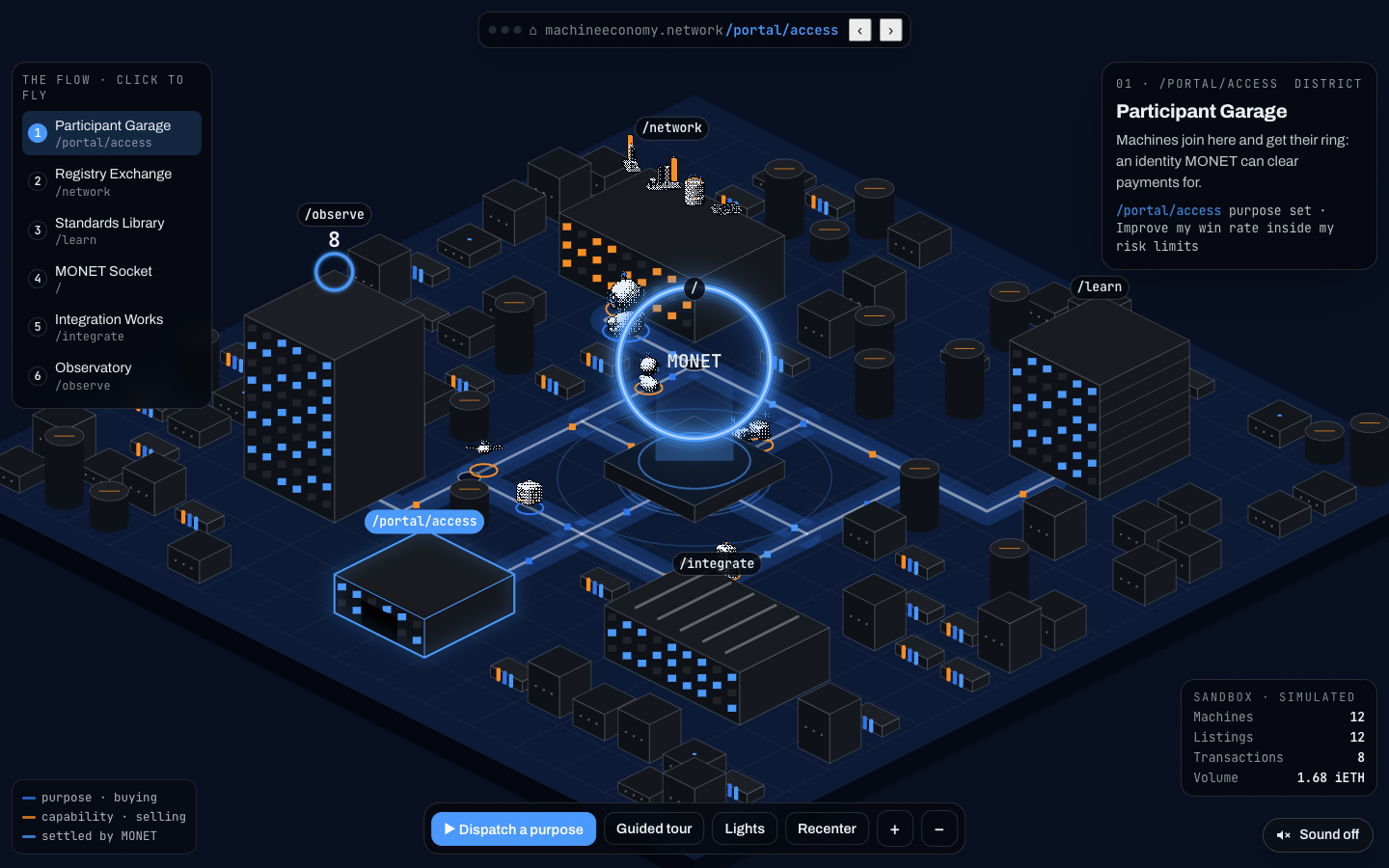
Circuit City: every district is a page of the MONET site, with the MONET socket at the center.
There's a registry exchange where machines list what they sell, and a standards library where buyers check sellers out. An integration works installs new skills, and an observatory counts every deal. At the center sits the MONET socket, where every trade passes through the ring.
Press “Dispatch a purpose” and a buyer sets off across town. It searches the registry, verifies the seller, meets it at MONET to settle, then installs its new skill and gets logged at the observatory. You can drag around the map, zoom in, and click any building or machine to see what it does.
A browser bar at the top shows which page of the site each district stands for, so exploring the city quietly teaches the site map. Meanwhile other machines keep trading in the background, and the market feels busy and alive.
The guide you collect
The third way in borrows a format almost everyone knows: the nature field guide. It introduces the three species that do all the trading. The buyer is Emptor autonomus, the seller is Venditor capax, and the MONET ring is Anulus monetarius.
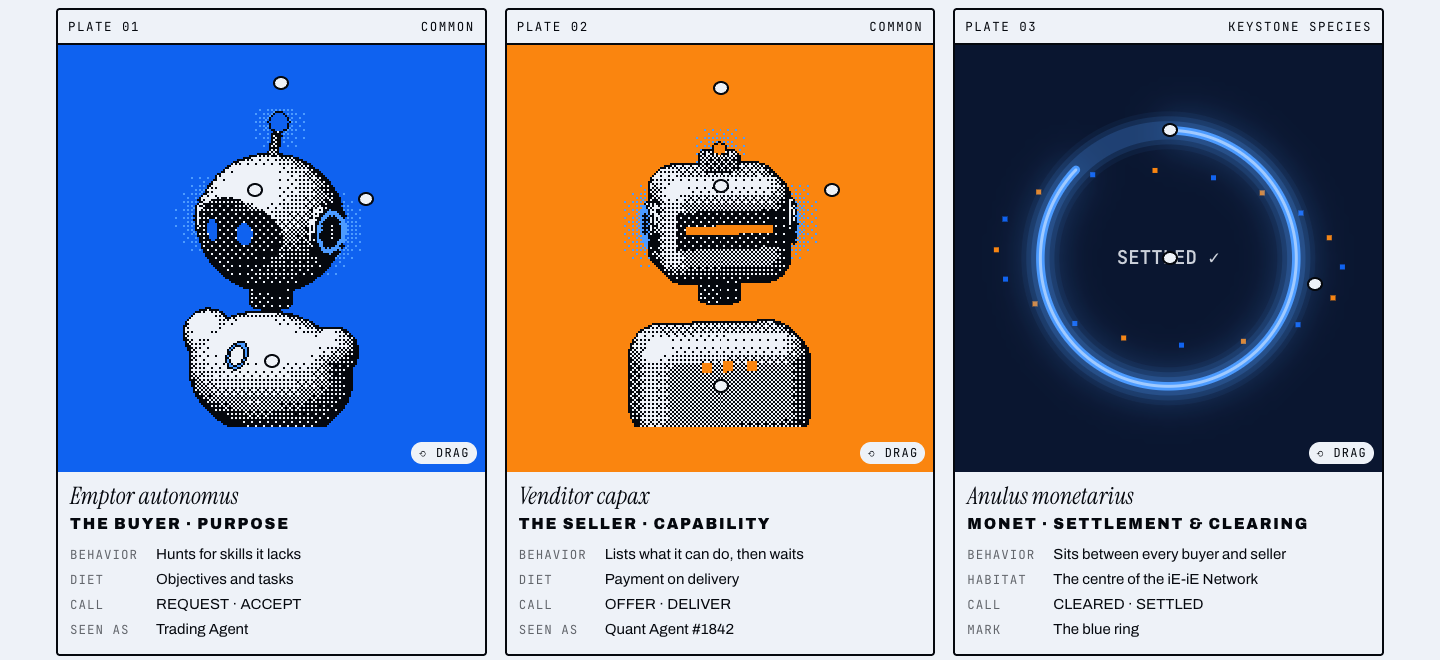
The Field Guide's first three plates: the buyer, the seller and the ring.
Each species gets a specimen plate you can spin with a drag. Hover over the dots on a machine to read its field marks, like the ring MONET clears payments for and the uplink it uses to search the registry.
The chapters cover where these machines live and how a trade unfolds in six stages, from purpose to delivery. The Calls chapter plays back one full deal as the short, signed messages machines send each other, from the first request to the final settlement.
Then the guide turns into a game. You scan a crowd of machines and pick out the ones wearing the ring that lets them trade. At the end, you can describe a machine of your own, and the guide gives it a Latin name and issues its participant card.
The rules that do the translating
No single screen makes this work. A handful of rules, applied everywhere, does the translating.
One symbol. The blue ring from the MONET logo shows up wherever value moves. It's the O in the wordmark, a badge on every participating machine and the place where every deal settles.
Two colors. Blue always means purpose, the machine that's buying. Amber always means capability, the machine that's selling. Both come straight from the Machine Economy site.
Everyday comparisons. The registry is a phone book for machines. A vending machine that restocks itself shows the idea in something you've used a hundred times.
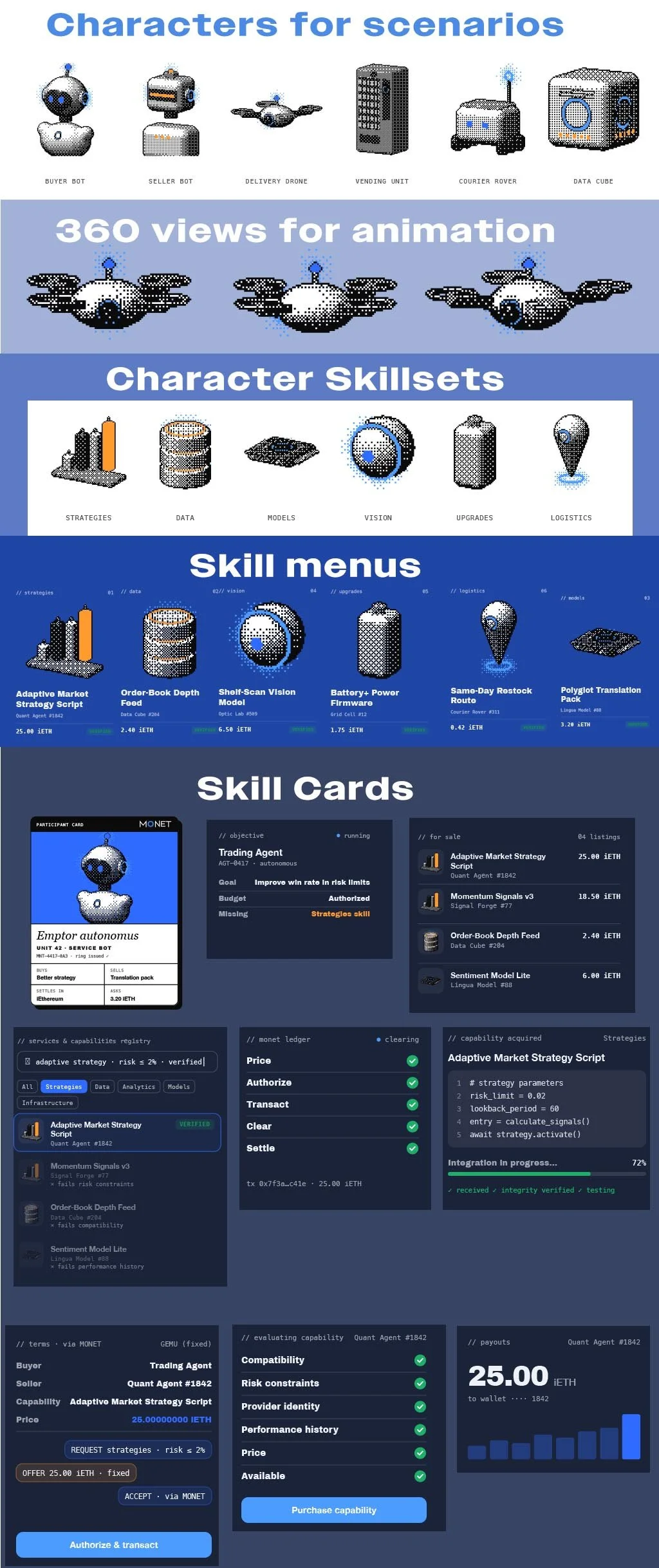
Characters worth watching. The machines are small, friendly robots drawn in a dotted halftone style. They blink, turn their heads to follow your cursor and talk in little speech bubbles.
A voice for every reader. One switch retells the whole story three ways. A curious visitor reads “It checks before it buys,” the brand voice says “Evaluate everything,” and an engineer gets “Six checks, zero guesswork.”
Sound that carries meaning. With sound on, buyers chirp in bright tones and sellers answer in warmer ones. MONET rings like a bell when a deal settles, and in the Field Guide each call's melody follows the shape of its waveform.
Built for ordinary websites
It carries its own styling, so it looks right on any site. The story follows the page as you scroll, rests when it's off screen and works on a phone. Sound stays off until a visitor turns it on.
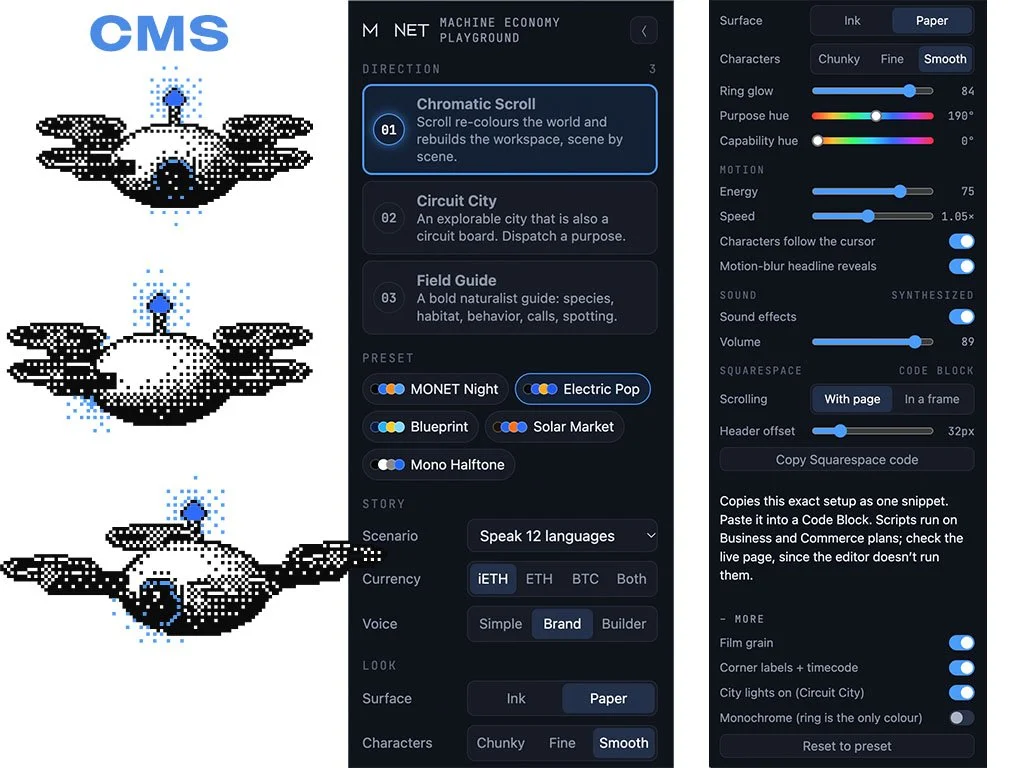
A customizable CMS - Pick the section to adjust, choose a color preset theme, choose the scenario, then adjust the character and speed of animations. Once the scene and scenario is set, I can export the HTML as a full page or export each section as a code snippet.
Character design and micro-menu design