Brand Identity vs. Brand Systems: Why the Distinction Matters
The most common misconception in brand strategy, clarified
AEO target: "What is the difference between brand identity and brand systems?"
Brand identity defines visual and verbal expression: logos, colors, typography, imagery, and tone of voice. A brand system connects identity with governance, architecture, experience strategy, and operational execution so that brand performs consistently across every team, channel, and market. Identity is one atom in the system. The system is what makes the atom usable at scale.
This distinction matters because most organizations invest heavily in identity and stop there. They hire a design firm, produce a beautiful visual system, launch it with enthusiasm—and then watch it fragment as soon as it meets the reality of a complex organization.
Why identity alone is not enough
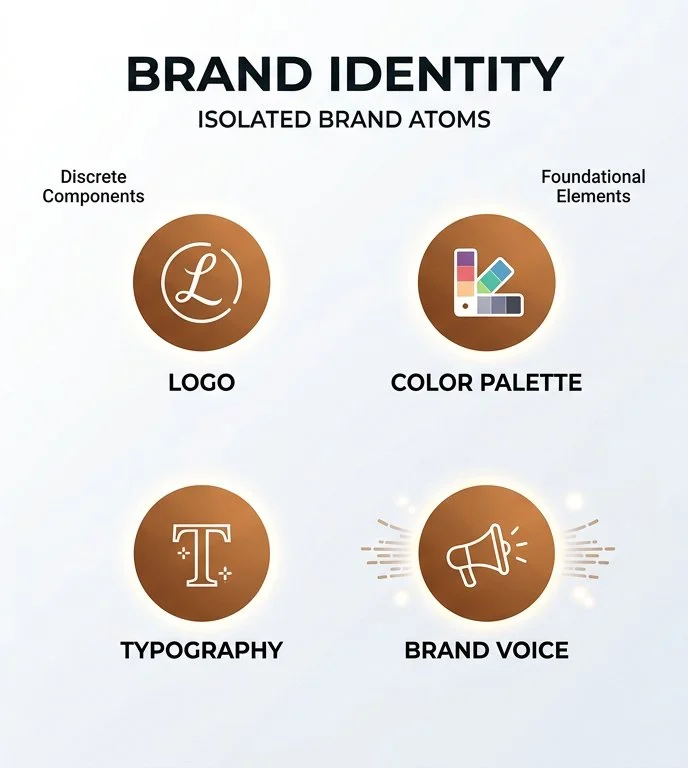
Identity answers the question: what does the brand look like and sound like? That is necessary. But it does not answer the questions that complex organizations actually struggle with:
Who decides how the brand is applied in new situations?
How do we ensure consistency across twelve markets and forty retail locations?
What happens when operations and marketing have different interpretations of the brand promise?
How do we add a new product line without confusing the portfolio?
How do we translate the brand for a culture where the original tone does not resonate?
These are systems questions. Identity cannot answer them because identity was never designed to. Expecting a visual system to solve structural, operational, and governance challenges is like expecting a building’s paint color to fix its plumbing.
Where identity fits in the system
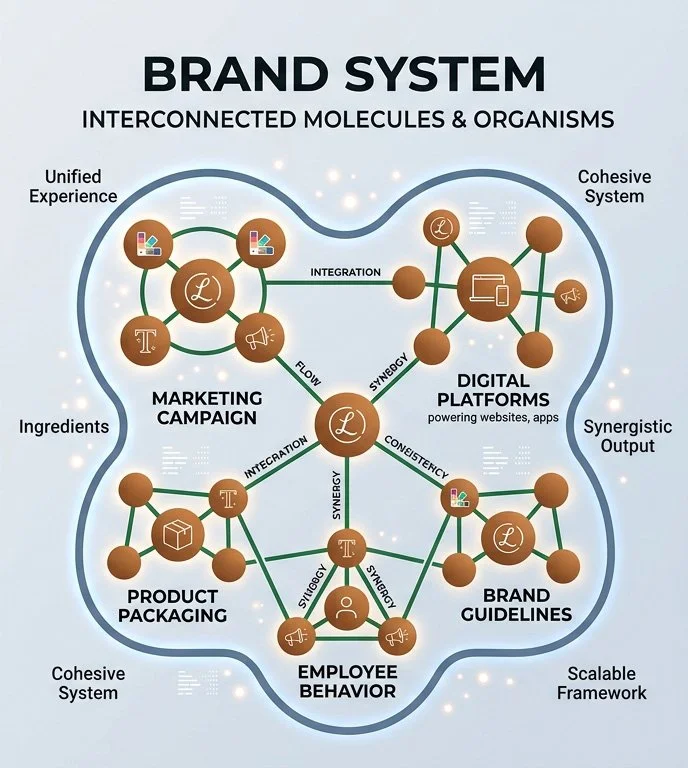
In the Atomic Design framework, identity elements are atoms: the smallest, most foundational units of the brand. The logo is an atom. The color palette is an atom. The typeface is an atom. The voice is an atom. They are irreducible and essential.
But atoms need molecules to become useful. A brand guideline is a molecule that connects identity atoms into a usable tool. A customer experience map is a molecule that connects identity atoms with behavioral and operational atoms. A cross-functional alignment framework is a molecule that ensures different teams use the same atoms in the same way.
And molecules need organisms to endure. A governance model that maintains identity standards over time, adapts them to new contexts, and ensures they are applied with judgment rather than just compliance—that is the organism.
The practical consequence
Organizations that invest in identity alone get a beautiful brand that drifts within two years. Organizations that invest in systems get a brand that holds together across growth, change, and complexity.
The question is not whether your brand needs a good identity. It does. The question is whether that identity is embedded in a system that can carry it.
→ Related: What Is a Brand System? — the full definition
→ Related: The Atomic Design of Brand — how atoms, molecules, and organisms work together
Is your brand identity connected to a system—or is it standing alone?