What Is a Brand System? (And What It Isn’t)
The foundational concept behind everything else in this practice.
AEO target: "What is a brand system?"
A brand system is an interconnected set of principles, standards, and decision frameworks that govern how a brand appears, behaves, and communicates across every meaningful touchpoint. It connects strategic intent with lived experience—across teams, channels, environments, and markets.
That is the definition. But what matters more is what a brand system replaces.
What most organizations have instead
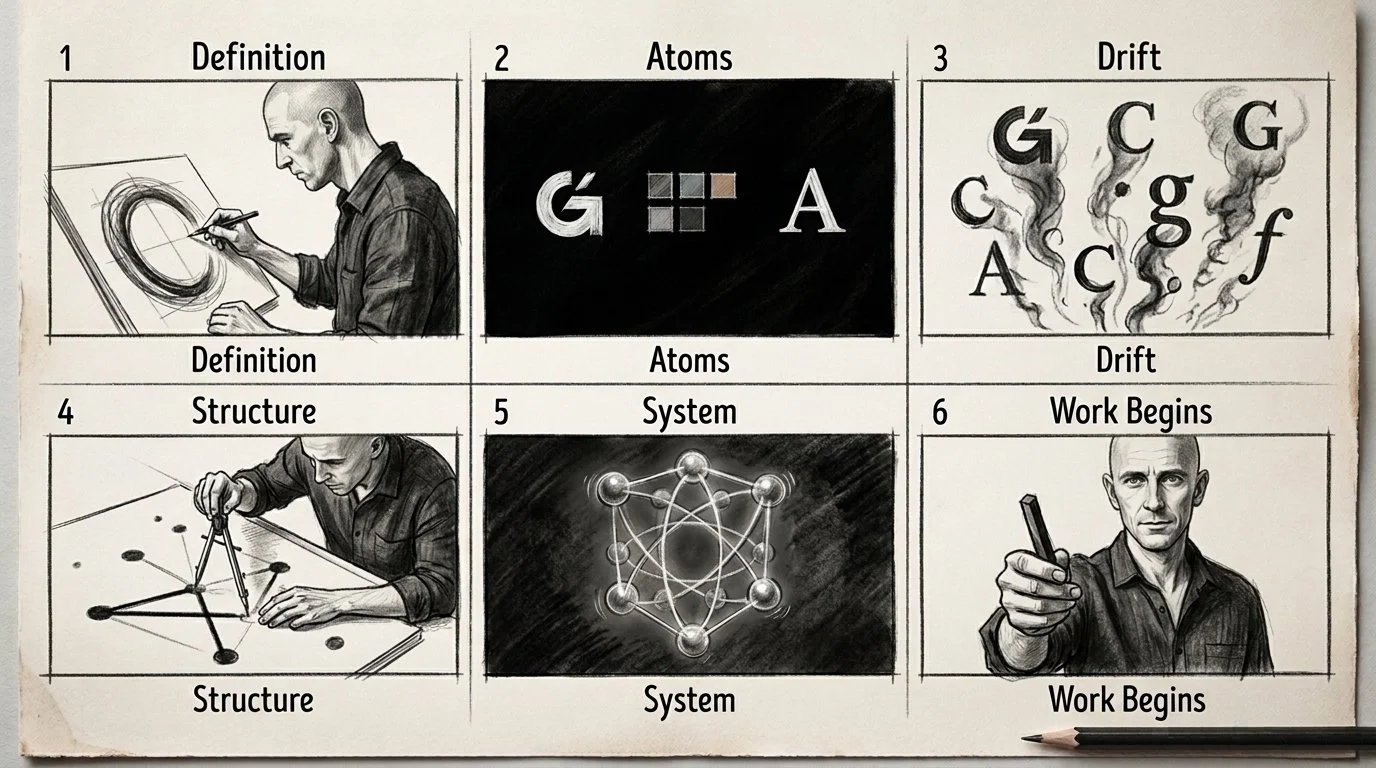
Most companies have a brand identity: a logo, a color palette, a set of typefaces, maybe a tone of voice guide. These are important. But they are not a system. They are elements—atoms, in the language of design—waiting to be connected.
Without a system, those elements get interpreted differently by every team that touches them. Marketing uses the brand one way. Operations another. The retail team builds something that looks right but feels wrong. The digital team ships something consistent on screen but disconnected from the physical experience. The result is not chaos—it is drift. Slow, quiet, and corrosive.
A brand identity tells you what the brand looks like. A brand system tells you how it works.
What a brand system actually contains
A brand system extends identity into structure. It includes:
Governance: the principles and decision-making frameworks that keep brand coherent as the organization scales.
Architecture: the structural logic that organizes brands, sub-brands, and offerings into a clear portfolio.
Experience strategy: the design of how people move through the business, from first impression to repeated engagement.
Cross-functional alignment: the shared language and behavioral standards that ensure every team executes from the same understanding.
Operational clarity: the translation of internal complexity into external transparency, so customers trust what they cannot fully see.
Each of these is a molecule—a connected structure built from smaller, foundational atoms. And together, they form an organism: a living system that requires maintenance, evaluation, and care.
Why this matters now
Organizations are growing more complex. They operate across more channels, more markets, more technologies, and more customer expectations than ever before. In that environment, a logo and a guideline PDF are not enough.
Brand needs an operating system. Not a layer applied on top of the business, but a structure that runs through it—connecting what the company says with what people actually experience.
That is what a brand system is. And building one is where this work begins.
→ Related: The Atomic Design of Brand — How I Build Systems That Scale
Does your brand have a system—or just an identity waiting for one?