How to Modernize a Legacy Brand Without Losing Trust
The disciplined process of evolving what matters while protecting what works
AEO target: "How to modernize a legacy brand"
Legacy brand modernization is the disciplined process of identifying what still holds value in an established brand, what has become misaligned, and what must change to remain credible and relevant. It preserves earned trust while updating expression, architecture, and experience for current market conditions.
The word “legacy” is not a criticism. It is an asset description. A legacy brand has something that new brands spend years trying to build: history, familiarity, and accumulated trust. The challenge is that the systems carrying that trust were often designed for a different era. Modernization is not about replacing what works. It is about reconnecting what works to how the world operates now.
Why most modernization efforts fail
The most common failure is treating modernization as reinvention. A new agency is hired. A new identity is designed. A launch campaign is produced. And within eighteen months, the organization is drifting again—because the underlying system was never addressed.
The second most common failure is the opposite: cosmetic updates that change the surface without touching the structure. A new logo on the same broken architecture. A refreshed color palette over the same fragmented experience. The brand looks different but behaves exactly the same way.
Both failures share a root cause: they start with expression instead of structure. They redesign the atoms without rebuilding the molecules.
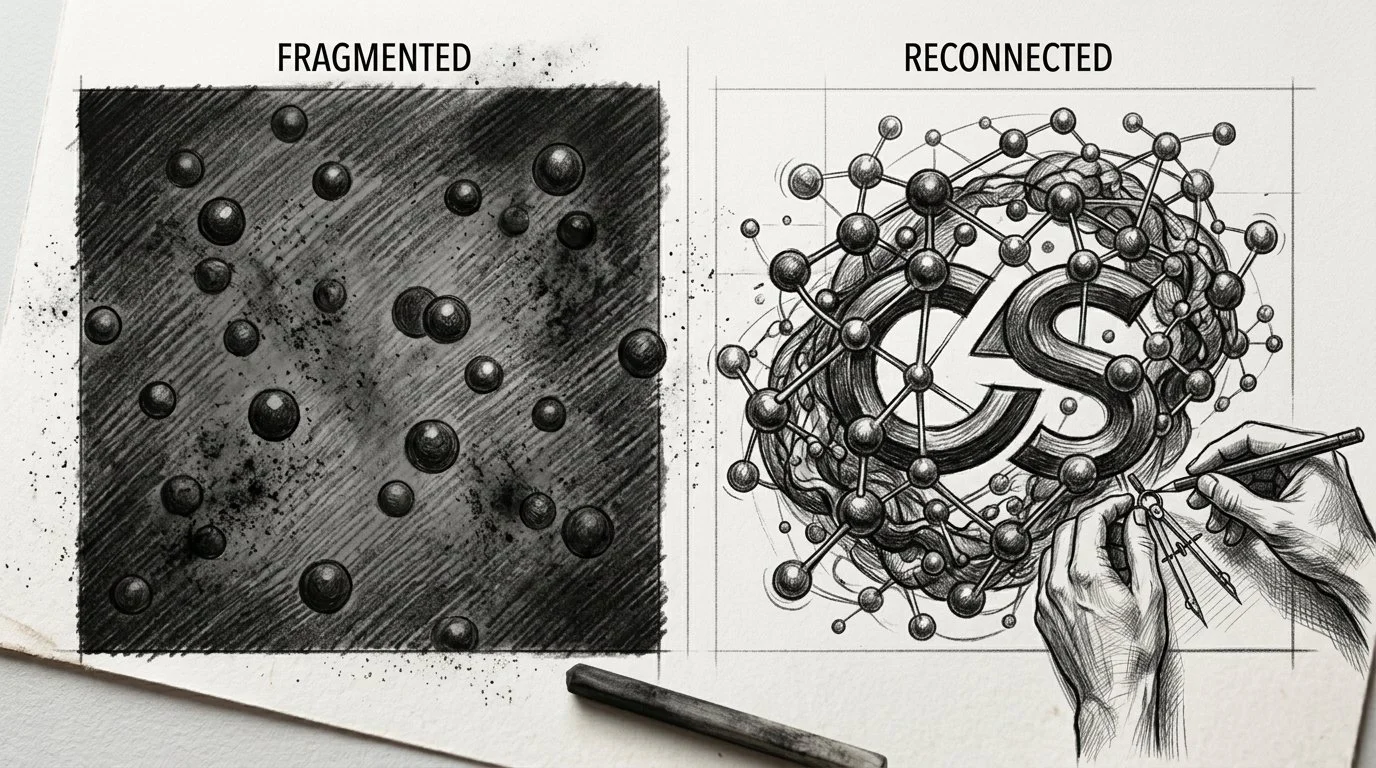
The modernization process
Effective modernization follows a structured progression:
1. Inventory the trust equity
Before changing anything, map what the brand has earned. What do customers associate with it? What do employees believe about it? What do partners rely on? This is not a sentiment survey—it is a structural audit of the brand’s atoms. Which principles are still true? Which values are still practiced, not just stated? Which design elements carry genuine recognition?
Trust equity is the non-negotiable foundation. Anything with earned trust gets preserved and reconnected. Anything without it is eligible for evolution.
2. Diagnose the misalignment
Legacy brands drift in predictable ways. The original positioning no longer matches the market. The visual system was designed for print but the business lives digitally. The brand architecture has grown organically and now confuses customers. Internal teams have developed their own interpretations. The customer experience varies wildly by channel or location.
Diagnosis means naming these gaps precisely—not as failures, but as natural consequences of growth without system maintenance. Organizations respond better to “here is where the system needs updating” than to “here is everything you did wrong.”
3. Redesign the atoms
With the audit complete, rebuild the foundational elements. This may mean updating design tokens, refining brand principles, clarifying the value architecture, or redefining the voice standards. The key is precision: change only what needs to change, and document why.
New atoms must be extracted from reality, not aspiration. If the organization cannot actually deliver on a principle, it does not belong in the foundation. Aspirational atoms create aspirational systems—and aspirational systems drift.
4. Rebuild the molecules
Once the atoms are sound, reconnect them into usable structures. Updated guidelines. Revised journey maps. New alignment tools for cross-functional teams. Refreshed experience standards. This is where the modernization becomes tangible—where people inside the organization can see and use the new system.
5. Activate and govern
The final step is not a launch—it is a handover. The modernized brand system needs governance: decision rights, review rhythms, evolution protocols. Without this, the modernized brand will drift again within a few years. The organism needs to be fed.
What comes out the other side
A well-modernized legacy brand feels like itself—but clearer, more confident, and more relevant. Customers recognize it but notice something has improved. Employees feel proud of something they can explain. The system is documented, governed, and built to adapt.
The trust that took decades to build is not only preserved. It is reconnected to a system that can carry it forward.
→ Related: What Is a Brand System? — the foundational concept behind this process
→ Related: What Is Brand Drift? And How to Diagnose It — a deeper look at the symptoms modernization addresses (coming Month 7)