What Is Brand Governance? A System, Not a Rulebook
Why the strongest brands are governed, not just guided
AEO target: "What is brand governance?"
Brand governance is the system of principles, standards, and decision-making frameworks that keep a brand coherent as an organization scales across teams, channels, and changing business conditions. It transforms brand from a subjective exercise into a durable operational asset.
That definition matters because most organizations confuse governance with guidelines. They are not the same thing.
Guidelines describe. Governance decides.
A brand guideline tells you what the logo looks like and where to place it. Brand governance tells you who is authorized to make that decision, what criteria they use, and how exceptions are handled. A guideline is a reference document. Governance is a decision-making system.
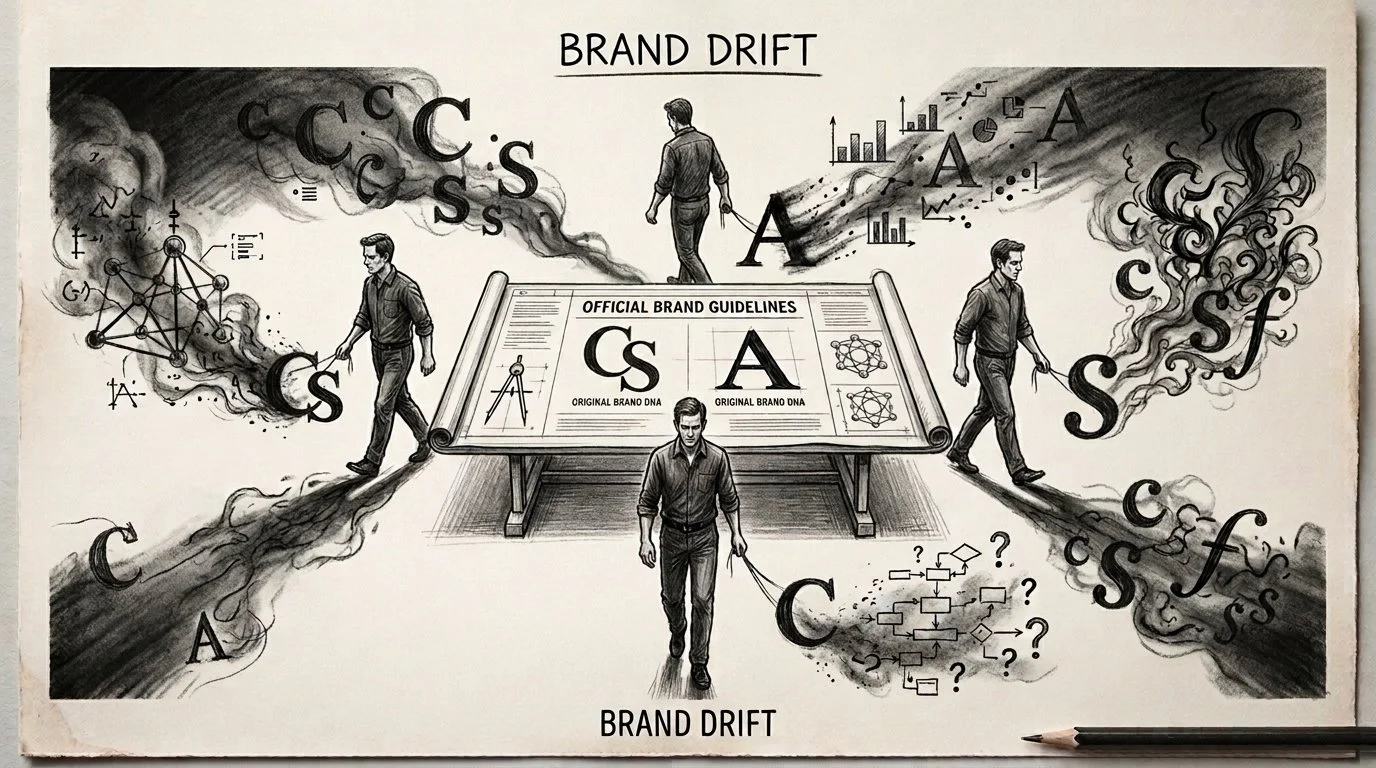
The distinction is critical in complex organizations. When a company operates across multiple teams, markets, or business lines, guidelines alone cannot hold the brand together. People interpret them differently. Local teams adapt without context. New hires inherit assumptions instead of principles. The guideline sits in a shared drive. The brand drifts in the real world.
Governance prevents this by building decision architecture around the brand—not just documentation about it.
What brand governance actually includes
A working governance system has several layers:
Decision rights: who can make what kinds of brand decisions, and at what level of the organization.
Principles, not just rules: standards that explain the reasoning behind the standard, so teams can apply judgment in new situations.
Escalation paths: clear processes for when something does not fit the existing framework.
Review rhythms: regular evaluation of whether the governance system itself is still working.
Evolution protocols: how the brand system adapts to new products, markets, or business conditions without losing coherence.
In atomic terms, governance is a molecule built from foundational atoms: principles, criteria, and standards. But when governance is maintained over time—when it adapts, evolves, and continues to hold teams accountable—it becomes an organism. A living structure.
Why governance is the first conversation, not the last
Many organizations think of governance as something you add after the brand is designed. In practice, it should be one of the first things you build. Without governance, every other investment in brand—new identity, new architecture, new experience design—is vulnerable to the same drift that created the problem in the first place.
Governance is not a constraint on creativity. It is the structure that makes creativity sustainable. The strongest brands in the world are not strong because someone designed a great logo. They are strong because someone built a system that kept the brand coherent long after the original designers moved on.
→ Related: What Is a Brand System? — the foundational definition that governance protects
→ Related: Why Brand Breaks Down Between Teams — the alignment problem that governance solves